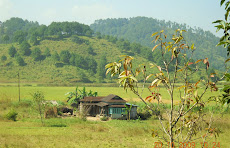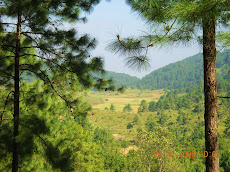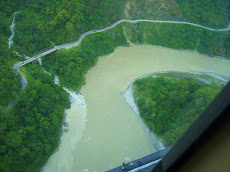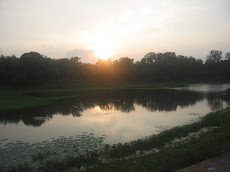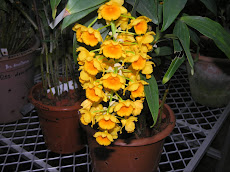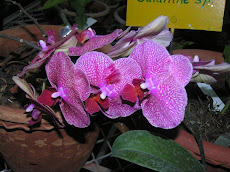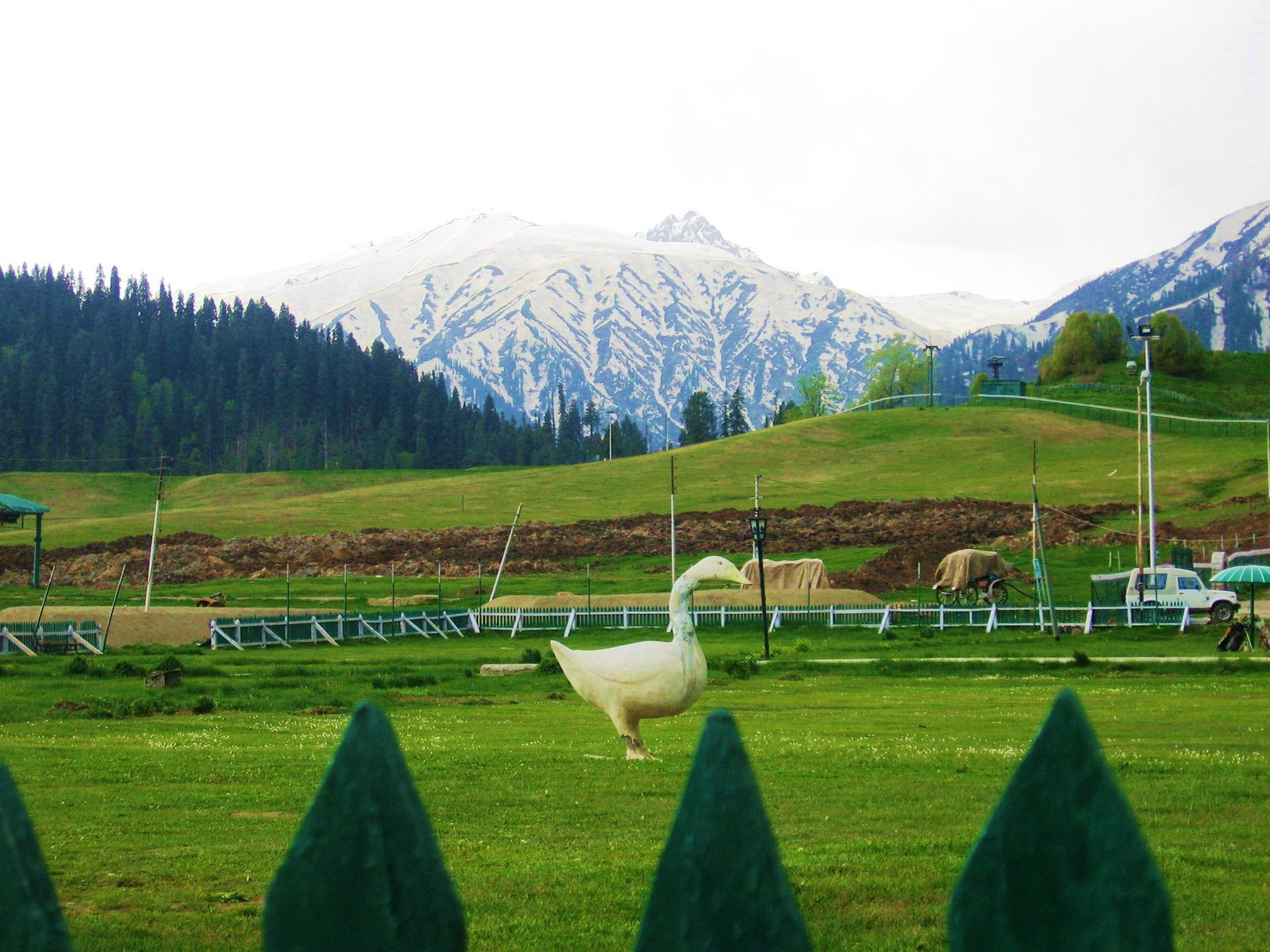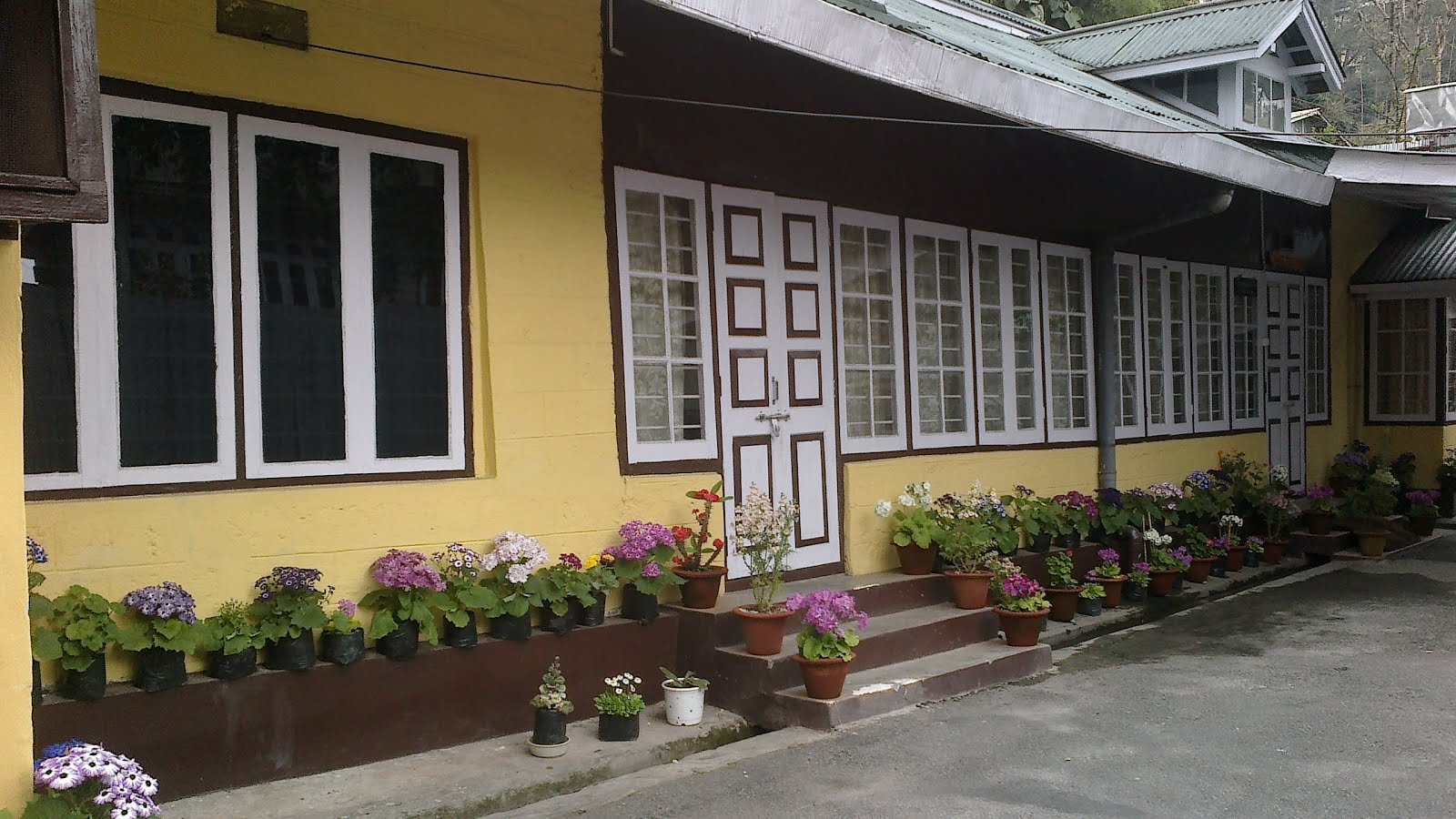
It’s a relaxing September Sunday morning at AIS Colony, Lumsey, Tadong (5th Mile). There is a bit of chill accompanied by occasional drizzle. While I reluctantly agree to scribble the fantasies of my never say die hubby, old faithfuls Tommy & Baily and our friendly neighbor walk into the eco friendly and green sit out having two attractive yellow benches. Upon settling on a parapet, Tommy looks straight into the green valley downhill. RPG, on the contrary, is all set to flaunt his new haircut. What a pleasure it is to see a ‘young man’ of 65 years with semi jet black crowning glory. No doubt, it is not a match with the black colour of the office diary kept on the bench or for that matter, black Samsung held tightly by him or the black Bolero of one and only Y factor.
Monday, November 26, 2012
BEE ONE, LUMSEY
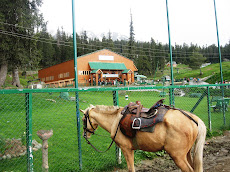
It’s a relaxing September Sunday morning at AIS Colony, Lumsey, Tadong (5th Mile). There is a bit of chill accompanied by occasional drizzle. While I reluctantly agree to scribble the fantasies of my never say die hubby, old faithfuls Tommy & Baily and our friendly neighbor walk into the eco friendly and green sit out having two attractive yellow benches. Upon settling on a parapet, Tommy looks straight into the green valley downhill. RPG, on the contrary, is all set to flaunt his new haircut. What a pleasure it is to see a ‘young man’ of 65 years with semi jet black crowning glory. No doubt, it is not a match with the black colour of the office diary kept on the bench or for that matter, black Samsung held tightly by him or the black Bolero of one and only Y factor.
Friday, November 23, 2012
JNU Beckons
Magic of Broadway
Sunday, November 11, 2012
Wednesday, July 25, 2012
Rajesh Khanna: End of an ERA
Saturday, March 24, 2012
Chambal Crocodile Sanctuary
Decision to visit this prime biodiversity spot was a delayed one. Every one swung into action in limited time after relishing a relaxed lunch. Though weather was pleasant on reaching Sason Bridge around 4.45 pm, there was no clue to get down. Ajay Singh, PSO, in the meanwhile did mention about frequent assembly of large sized fish and crocodiles right below one temple dedicated to Lord Shiva. One km downstream, it was on the other side of the river. One lost no time in taking good shots of the clean and wide river in the fading sunlight. A bird akin to Owl but smaller than Eagle frequently and very romantically flew here and there, without giving any chance to shoot. A cousin of his was spotted very close to our dwelling place in Etawah a fortnight ago.
Immediate contact with the Circle Officer of Chakar Nagar through local police and Sri Manish, SDO, Bharthana(otherwise preoccupied with the sudden appendicitis operation of his son) ensured arrival of Sri M.S. Beg, SI, Chakar Nagar PS and his five armed policemen within 25 minutes. Not only they were familiar with the terrain but they had also summoned Sri Jaikishan, the Forest Dept. Motor boatman. Interaction with them revealed that they were more than eager to take us for a ride to the crocodile country at Jagtauli (8 kms away). A previous exposure of this kind to some other friends three weeks ago was going to be handy.
After a drive of half a km on a bumpy forest road through the mazes of ravines, we reach very close to the Chambal River. A wait of 15 or 20 minutes follows, still there is no trace of Jaikishan. We utilise the occasion to take a short walk on the green meadow on the bank and in appreciating sand formations below the crystal clear water. A few birds are spotted doing some exercise. Beg and his associates inform that sand as well as water of this place is very sought after, so much so, that one of the former S.P.’s used to have jerkins of water collected from mid-stream regularly for the sake of his stomach ailment.
Suddenly, we get the rare opportunity of seeing an adult crocodile below the pillar no. 4. Neither he was close by nor far off, but he was oblivious to our presence. Due to distance, although it was difficult to photograph, ripples caused by his graceful movement could be seen for some time. It was a rare sight to behold. We never knew that it was going to be the only ‘sight’ in broad day light.
At last around 5.25 pm, when sun started descending, Jaikishan, our Man Friday appears in his sarkari boat, having got delayed due to non-availability of required 10 ltrs .of diesel. From the word go, we begin questioning him: How many crocodiles are there in the sanctuary? , How far is the sanctuary?, Are we going to see any of the creatures since it was becoming dark?, How are protected species kept?, Was there any difference between the Crocodiles and the Gharials? etc.
On being prompted by Aditya Tiwari, one learns that the crocodiles had to wear a Kara (round bangle of iron) around their mouth, which enables them to attack and gulp only the small fish and that, supposedly, human beings were spared from their possible attacks. While crocodiles are a large long tailed reptile with powerful tapering jaws, the Gharial have very long slender muzzles. JK adds that we were going to see some Dolphins as well after a ride of 5 to 6 kms.
Luck seems to favour us around 5.35 pm when I was aiming at the sparkle created by the setting sun- one by one three crocodiles were spotted on the other bank of the river. At the first sight, we decided to ‘shoot’ at them with whatever photographic apparatus we had, though visibility was not very clear. Next option of taking the boat close to the bank was also exercised. Inevitable, however, happened and the crocodiles in question hid themselves below the water, sooner than expected. We had to be satisfied with what was in store.
One also saw a group of white cranes, multi-coloured cranes, snake birds, peacocks, Surkhav, a red coloured bird and a bird with a prominent cap. The last named gave ample ‘opportunity’ to be shot but somehow, we had a miss. It was interesting to hear, however, from Amit at this juncture that Charwa, a hefty animal of the size of a lion frequented this area and that the widely prevalent jackal was not lagging behind in destroying the crops.
As it was getting dark, we pass very close to Mithali village. Everyone was relishing the sunset so much so that stillness of the deep water did not attract till one of us decided to taste it. JK added to our information bank by whispering that depth of the river over here was 5.55 metres.
What a wonderful sight we saw next once again on the left bank. It was soothing mustard field against the brown and green background of the ravines, thus creating a brilliant reflection. Very close by was the Shyam Baba ka temple, once again dedicated to Lord Shiva. The depth of river had increased to 10 metres, by now, as per JK.
As if the sight of soothing mustard field was not enough, we were blessed with a marvellous view of one peacock walking leisurely on the bank. Oh yes, it was not alone, there was one more slightly away, may be its pair. They seemed to be in romantic mood. Fresh photography was resorted to when we saw green fields once again on the bank. Reflection was more mesmerizing than the actual object.
When attention was being taken away from the crocodiles, it was the turn of Dolphins to enter the fray. Around 6.05 pm before we pass by Kela village, JK shows three of them pursuing their playful antics in water while coming out to have a breath of fresh air. Though we could not figure out their appearance and size, ripples caused by them in otherwise stagnant water were sufficient to mark their dominating presence in close vicinity.
By 6.10 pm we enter the sanctuary area at Jagtauli. As water was stagnant here, depth was reported to be 10-12 metres. Despite our prayers, no crocodile could be seen on the vast beach. Ideal time was reported to be between 12 noon and 4 pm. The isolation of the place, together with the depth of the river had made it a perfect setting for the breeding and nursing of the crocodiles.
To satisfy our urge, therefore, we looked for them on the small green islands. They were not there as well. When we finally left the boat to walk on the green right bank, all of a sudden, JK pointed towards ripple in the water, very close by. The crocodile over there did not appear to be in a hurry as compared to his previous ‘friend’. The view was better and closer but darkness was a hindrance. Within five minutes we were lucky to see another one. We did not leave the place immediately, though there was no hope to have another ‘sight’. By breaking ourselves into sub groups, we began exploring the area. This crocodile centre having a population of over 200 crocodiles and 1600 gharials was only of its kind in the country. The rare Ganges river Dolphin, the sole member of the Cetaceans group was reported to be one of its most prominent attractions. In addition, 150 species of birds are also sighted here.
The stories of Phoolan Devi, Seema Parihar, Kusuma Nain, Rajjan, Lovely, Salim, Nirbhay Gujjar etc. all dacoits, who used to throng the place once upon a time during their transit, keep us occupied after we were free from the natural wonders of the sanctuary. One has to hear their tales, as primarily due to their presence till the seventies, this wonderful habitat was not exposed to the outside world.
Before it gets really dark, a glorious moon rise over the east bank, in a way, gives us a befitting farewell. It was a pleasure to photograph it from the colony of crocodiles as also the boat when our retreat to Etawah begins. No longer, it is a hurried affair. All the boat occupants begin to enjoy biscuits and cold drinks to beat the monotony. We do not forget to express our profound gratitude to J.K and M.S. Beg for having exposed us to the pristine river ecosystem of Chambal. In a nutshell, it was quality versus quantity. And quality won, in the ultimate analysis.
Tuesday, March 13, 2012
Taj, You cannot have enough of it
Cameras begin clicking almost immediately, so much so that the first few shots have to be ultimately reviewed and deleted altogether. Why shouldn’t we take advantage of rapid digitization? The touch pose by raising one’s arm and ‘placing’ the same on top of Taj was the most prominent one, followed instantly and religiously, almost by everyone.
A foreign couple (forty plus lady sporting a backless halter gown) and their jeans clad Indian counterpart were frequently spotted. They made no mistakes in getting noticed and leaving an indelible mark. Expectedly, young couples from the length & breadth of the country were there to grace the occasion. Children & tiny tots did not lag behind in posing for the camera. The group (100 odd), however, which convincingly stole the slow comprised of fresh tall recruits of the BSF. It appears, they were feeling liberated from long and tiring election duty recently. High spirit, therefore, was all pervading.
At the traditional posing marble bench, there was a complete jam, so much so that one had to wait for one’s turn for nearly 15-20 minutes. It was worth it as you do not visit Taj every day. And the sun light was picture perfect. It was festive spirit that dominated.
While Indians by and large would begin shooting at the drop of hat, the foreigners in general would look, stare, admire and thereafter aim and shoot. Most of them if part of a group, would listen attentively to the live commentary (in the language they understood) delivered by the professional guides. Latter, invariably would come out with a yanky accent, while reiterating the grand old tale of the Emperor Shahjehan and the Queen Mumtaj Mahal.
An interesting snap session of a South Indian daughter & son-in-law, meticulously “conducted” by a father with photographic bent of mind reflected the overall change in the attitude in respect of portrayal of love in public places. Father was excited no doubt, but the mother could not suppress her traditional outlook even when affection and exhilaration had their way.
The monument built in 1653, per se, is so grand, imposing and massive that it is almost a two kms walk to cover its 42 acres. And one does not feel tired. Rather, one relishes it. It looks the same from three sides- East, West and South. The north view, one cannot see because of partly polluted Yamuna at the rear.
Carvings, inlay work and calligraphy on all sides are not only gorgeous. They are outstanding masterpieces. The beauty of minars can be admired only when you get closer. There were no architects, no civil engineers, no aesthetic consultants nor steel was used six hundred years ago, yet, such a fine specimen of architectural rationality saw the light of the day after a labour of love of twenty thousand workers for twenty two years.
Traditional reflecting pool view of 81 feet high Taj is definitely admirable but the view from inside the main gate or from one of the jumbo gates on the bank of Yamuna, simply defies description. Not only you are spellbound but you feel like meditating. You do not think of anything except Taj. The experience acts like a true stress buster.
All the talk about change in the colour of Taj from white to yellowish cream is hogwash. After two hours of close look, it can be safely concluded that the marble marvel is still not only sparkling, but it leaves you simply flavorgasted.
Surroundings of Taj and the main courtyard are spotlessly clean. Scene around the ticket windows, however, needs face lift and decongestion. The approach road is much better than what it was a few years ago. However, the city police have to do its home work to regulate traffic properly. Coming to conveyance, apart from the cycle rickshaws, introduction of camel carts and battery vans operated by the A.D.A. from the parking lot is eco-friendly and sustainable addition. Besides taking care of environment, these also act as great levelers.
Taj can earn more money for the country if it is more aggressively sold and the touts, agents and the transporters are systematically regulated, if not eliminated. Only upkeep and non-penetrable security won’t do. The access to the Taj also has to be clean, presentable and non-cumbersome.
My fourth visit was not exactly “satisfactory” as you cannot have enough of Taj. At the end of each visit, one vows to come again.
Monday, March 12, 2012
Sunday, March 4, 2012


ETAWAH KA BULAWAH
Relatively unknown District of Etawah appears non-descript till you actually plan a foot fall. Surrounded by Agra, Firozabad, Mainpuri, Kannauj, Auraiya, Jalaun and Bhind (MP) Districts, it is not far off from the ultimate tourism destination of Agra (120 kms), princely state of Gwalior (110 kms), epicenter of bangle industry, Firozabad (50 kms) and Shan-e-Awadh, Lucknow (250 kms).
Infinite patience helps when journey is long even if one has access to the latest Japanese SUV, moving at a dumbfounding speed of 90 kms per hour. The first break after three and a half hours enables one to avail of public convenience in addition to a quick bite of two varieties of parathas (potato and paneer) and curd. Before the belly is filled up, a walk at a leisurely pace looking at road side villages cannot be resisted.
Famous for Rabri, Peda and its gun loving populace, of late, the vibrant Sub-division of Saifai has added fresh feathers to Etawah’s cap by making possible super speciality medical care, world class sports centres, plethora of educational institutions and a 2700 metre long ‘uncontrolled’ aerodrome. Other notable townships-Jaswant Nagar and Bharthana, surprisingly, are lagging behind. The overall prosperity reflected from the upgraded infrastructure, however, does not seem to have made any dent on the sanitary standards and attitude towards the fair sex.
On reaching our abode for one month (in two phases), one gets an impression that this was the place where one could relax, unwind and regain one’s peace of mind. While chirping of countless, colorful birds touch your heart, you also have a chance to watch slow and graceful walks of Crocodiles, Peacocks, Barasingha Deers and Nilgais. Existence of natural wet lands and pools of water due to spill-over from the tube wells, has, perhaps, led to proliferation of fauna if not flora. You are privileged to see everything: Parrots, Eagles, Cranes, Wood Peckers, Snake birds, Pigeons, Black & Brown Crows, Crows with long tail, Koels, Mynahs, Neelkanth, Dhaurayyas, Titar, Mahuka, Gulgulia, Chanduls and Swans. Resultantly, one feels as if the whole place resembles an open, unpolluted and undisturbed sanctuary.
The very first outing takes you to a different world. If Mustard fields are stunning, those growing Potato, Garlic and Wheat look enchanting to an urban dweller. The healthy growth of Sugarcane reminds one of one’s childhood, when there would be scramble between the Siblings for the best ‘cut-piece’. In the vast ‘ocean’ of green fields, there are alkaline ‘islands’ (Usar land) as well. Chemical treatment makes such plots worthy of wheat cultivation.
The Sumer Fort area (originally built 1100 years ago) lures you with its unusual beauty and green landscape in the backdrop of often talked about ravines. While Yamuna is right across, Chambal is barely 10 kms away. Former, despite attracting birds is as polluted as in Delhi. Latter looks somewhat clean and calm. A motor boat ride on the river ahead of Hanumantpura takes you to an exhilarating interface with crocodiles looked after in a sanctuary.
In the glaring light of the mid-day sun, gradually you see baby crocodiles basking and relaxing on the beach, while the adults enter blue deep waters in search of some ‘catch’. The Swans, Cranes and Snake birds do appear every now and then. While they enjoy, they enhance the beauty of the surroundings. The best way, however, to have a feel of the place is to leave the motor boat and walk slowly along the bank to relish the moments of solitude.
The Chambal river has been witness to tales of valour and miseries associated with the dacoits, many of whom turned to kidnapping before withering away. Their influence over the ravine villagers has been full and complete, so much so that either the latter would not vote or exercise their franchise according to whims and fancies of the former. During the recently concluded elections, the scenario, however, was positive (60 %) and reverse.
Coming to the look or the effect of Sun, while its rise from the Fort can be awesome with cool breeze blowing from Yamuna, its ‘setting’ behind Chambal river is equally breath taking and mesmerizing. You simply draw incalculable pleasure out of the gradual ‘slide’ of the ‘red ball’. The sight of rise of Moon with a twinkling star in close proximity is also something one can concentrate upon, almost every evening. Such experiences give you comfort and courage to forget your stress and enable you to move ahead with renewed vigor and vitality in your regular work place.
Saturday, February 25, 2012
Aah or Oh TAJ ?

India’s marvelous marble mausoleum has instant magnetic effect. One of the Seven Wonders of the World and the country’s number one show piece, it is located 200 kms south of Delhi. It is a long, arduous journey, even though one has the privilege to pass through a national highway having four lanes.
My advance reading reveals that only one out of eleven travellers globally visits TM. Nevertheless, 90% of the domestic tourists do not give it a miss. There is a need, therefore, for tourism campaigners in India to wake up and sell this priceless product. They are in dire need of an overhaul.
One is sure of one thing associated with Taj – its aura, charm, mesmerism, the refreshing and soothing effect it has on you- in the morning, noon, evening or a full moon night.
x x x x x x x x x x x x
A fresh opportunity to have a brush with the Taj comes on 18th February. I get down to Agra Cantt. at 11.45 Hrs. from 12808 Samta Express. Approach to the station is dirty and full of poly bags. People defecating in the open, without any regret or shame bring in more of embarrassment. When the train had slowed down, urchins and teenagers were also seen jumping to bogies, presumably for a free ride.
Upon successfully negotiating the congestion in the outskirts, we enter clean parts of Taj city. Good signages but of low height welcome the visitors. I wish uniformity is maintained when it comes to colour scheme or size of hoardings or mile posts. There is a plethora of hotels, restaurants, travel agents and currency exchanges. One can also see riot of colours when bag packer foreigners rub shoulders with local semi-urban populace.
Good sights of the historic city turn out to be a temporary phenomenon. Before sensing a shred of traffic jam, we are lucky to get a glimpse of Taj. The view is better as compared to the earlier one. As a result, six to eight shots are possible. Getting close to the Yamuna was a good decision from photographic point of view but it turned out to be a disaster from the environmental angle. Dedicated and reliable Deepankar accompanying me too nods his head. It seems as if Agra & Delhi are having a cut throat competition to pollute the river. After a drive of almost two kms. one cannot locate any effluent treatment plant.
While being trapped in traffic for more than an hour one notices the following: people lack civic sense, traffic police constables are conspicuous by their absence, noise pollution is extraordinarily high, strong nexus between agents, touts, transporters and hoteliers of different hues results into compromising country’s prestige, people do everything on the road from basking in sun, washing clothes, taking bath to hanging their under garments, etc.
All means of transport, viz, buses, trucks, cars, vans, SUV’s, rickshaws, cycles, scooters, mobikes, tractors and three-wheelers compete with each other for a space on road. Practically every known business is carried out along Jeevani Mandi Road with scant regard to two World Heritage sites.
Before departing, one learns with satisfaction that the magnitude of congestion and pollution in this part is much lower subsequent to some courageous and path-breaking initiatives taken by the District administration and the Supreme Court a few years ago.
ARE THE CONCERNED AUTHORITIES STILL ACTIVE & AGILE?
All said and done, it is believed that second or third visit to a tourist spot or a monument is a friendly encounter. Apart from fine tuning knowledge, it reignites the emotions. I can candidly and confidently surmise that after this visit to Taj, substantial value was added to my cognitive and sensorial responses. At least there was fresh impetus to draw inspiration from one’s heritage and maintain a positive and optimistic approach to move ahead.Wednesday, February 15, 2012
VISIT TO PANCHNADA


(14.02.2012)
Departure for this truly relaxing spot situated at a distance of 57 kms. is at 7:45 am. It is not a clear day, but not a cold one either. Tension free Etawah residents are seen gradually leaving their bed to resume their daily chores. A drive of 20 kms on six lane National Highway towards Kanpur (160 kms) takes us to Bakewar.
It is nice undulating terrain through the ravines, a part of which was a happy hunting ground to famous dacoits: Mohar Singh, Madhav Singh, Malkhan Singh etc. before they laid their arms. Landscape and forest cover ahead reminds one of JNU campus in Delhi. Within half an hour of drive, we come across a beautiful Peacock comfortably seated atop a high mound. I am tempted to ‘shoot’ with my repaired 5.5 megapixels Canon Camera. Next, we hit Chakar Nagar, a small but dense Kasba. Very soon Yamuna river appears. It is wider and cleaner than at Sumer Hill, our exorbitant temporary abode overlooking road to Bhind (40 kms) and Gwalior (125 Kms).
After barely five kms, we see Chambal river. It is awesome. After all, it has a history behind it. It looks fabulous in morning. One learns that there is an impressive Crocodile sanctuary on its southern bank. I promise to come again. Further drive of a few kilometers on the well-maintained district road leads to Hanumantpur. One turns left and begins the last part of drive of 20 kms to Panchnada.
There is a slight change in terrain. It now looks like a plateau. Not every portion of land appears cultivated. Mostly one sees Mustard, Wheat and Sihuwah (cooking oil extracted from it). Birds are not that many, for want of wetlands. A striking feature is a ‘Scare Machan’, located in far flung corner of a wheat field. A rope is tied to pull it when animals intrude to have a free ‘feast’. Reportedly, the rope is also tied to a drum to produce sufficient noise. Thana Bitholi, a sort of ‘Kala Pani’ for Policemen emerges at 9:00am. It is the last Govt. or private establishment of the District.
Typical earth mounds of ravines having several huts with low roofs are located here and there. Cultivation is being carried out in small plots mainly in the depression areas. It is Babool vegetation that is all pervading.
Suddenly we see a beautiful 0.5 km. long high RCC bridge inaugurated barely six months ago. Looking at the scenario we have the reason to believe that our destination is at a stone’s throw. Underneath flows a river that has amalgamated waters of Sindh, Kuari and Pahuj streams. On the left is the mighty Yamuna in which the Chambal river has already merged two to three kms behind. Thus, contrary to the popular perception, five rivers do not actually meet each other, rather, they may have joined ‘hands’ at more than two places prior to the main confluence point at Panchnada.
A gentle walk over the bridge enables us a soothing glimpse of plenty of Peacocks, Parrots and other birds flying cheerfully over Wheat and Mustard fields situated close to river. A good photo opportunity of both sides slips away as a mild fog refuses to subside. A few shots are, nevertheless taken both from static and mobile cameras for posterity. We walk next to Rampura village of Jalaun District. The infamous Gudapurva village associated with the legend of Phoolan Devi is reported to be 65 kms away. One or two Babri kind of structures dominate the upper land overlooking amazing Yamuna.
Also visible is the vast beach on the other side, to be precisely falling in Auraiya District. The fog clears up by the time we reach a Temple to get a commanding view of the river. A ruin of hundred Satis also attracts attention. We attempt to soak into the overall pleasant experience by walking down to river through the green Gram fields. We feel sorry for the concerned authorities for not having ‘sold’ this beautiful destination to the tourists by providing basic information together with infrastructure.
Boating for twenty minutes gives us immense pleasure. We see four or five varieties of birds, all enjoying the pleasant and serene atmosphere of confluence. The water of Yamuna river is clear while slightly muddy water is seen flowing from the group of 3 rivers. Little bit of stench too is experienced on one side. It is quite a contrast from the Sangam at Allahabad. As per Shiv Pal, the tough boatman, depth of Yamuna over here varies from 20 to 30 meters. No wonder, she looks changed, fairly wide and calm.
While we turn finally, we recount what an exhilarating experience we had on seeing bunches of fish taking jump after jump, like professional swimmers. Equally memorable was the balancing act Vinay Kumar, the helper to boatman displayed while fiddling with two mobiles in a standing posture on the moving boat.
Visibility is again bad when we return to banks. Sun, however, is showing a rising trend. Ringing of temple bell reminds me of my remaining duties as Observer. I barely utter a thanksgiving word to the boatman as a welcome call comes from Professor Prabhakar from Japan. He seems to have liked my last night E-mail account of Etawah District. To him, it was not a message, it had all the ingredients of a full-fledged article.
After finishing conversation, I manage to ‘shoot’ a Neelkantha. She is contemplating in isolation. Thereafter, I enter the comfortable and reliable Innova on a satisfying note. We cross over the RCC bridge once again. On partial restoration of visibility, a few snaps of ‘T’ point are taken. The Chambal, however, continues to evade. We hit the road again in full speed, this time through the ravines facing Bhind to catch up with the hustle and bustle of electioneering.
Wednesday, February 1, 2012
Destination Tuensang (Aug 2010)
Two young officers of NEPED, an authority of Govt. of Nagaland (primary concern–energy and environment), warmly receive me. Though baggage clearance is a time taking affair, the serene and hassle free atmosphere in the arrival hall is a welcome wind of change. Drive to designated hotel is not a long affair. Getting into an almost brand new Bolero reminds me of hilly terrain of Sikkim. Looking at pools of water, I am informed of the rain that took place previous evening and early morning.
The private hotel at Dimapur looks impressive, neat and clean. Presence of a few foreign ‘smoking’ women gives an indication that tourism in this part is surviving if not ensuring economic returns to the common man. The service, however, is discouraging. As a result, we have to spend more than an hour to have breakfast and a short meeting with CCS, Planning, Govt. of Nagaland and his Joint Secretary, also associated with NEPED. On their suggestion, we decide to go to Tuensang via Golaghat in Assam. It is in contrast to the usual route via Kohima (76 kms), the state capital. Latter is supposed to be longer and more time consuming.
Sharp at 9.30 am, we leave the hotel to pass through 6 to 8 kms of completely flat portion of Dimapur. Population, at this time of the day looks sparse. In no time we enter Karbi Anglong Dist. of Assam. In the beginning it is Khatkhati village, followed by Bokajan, having an Army check post and a CCI cement factory. Next, we see a diversion for Numaligarh and Goalpara. It is a smooth drive on a good road, presumably, as it is a Sunday. Paddy fields are on both sides. After sometime one can see hills also as a backdrop.
By 10.10 am we reach Balipathar. The road sign indicates as if we are close to Jorhat Dist. Piles of firewood over machans remind me of similar practise followed between Muri and Ranchi in Jharkhand. The sight of black flags on vehicles surprises. One presumes that there is some cause for protest. But Takum Chang of NEPED informs that someone may have died and the burial may not have got over. Variety of small vehicles and pickup vans bearing both Assam and Nagaland number plates are negotiating slightly serpentine road going through thick patch of forest. One is reminded of roads of Middle Andaman in Jarawas area.
The river Garampani next catches our attention. A prominent board shows that there is a wild life sanctuary stretching upto Kaziranga. Around 10.40 hrs., one mile stone indicates that Numaligarh is only 45 kms away. Suddenly, a Mongoose crosses the road. It wakes up one of the officers from sleep. A village of Golaghat Sub- division thereafter comes before our eyes. A tri-junction (Tinaili) indicates that Golaghat town is barely 7 kms away while Numaligarh and Guwahati are located at a distance of 30 and 272 kms respectively. Once we shift from National Highway to the State highway, the condition of road can be very well imagined.
Golaghat, HQ of a District by the same name, is a sleepy one, having less of population and activity. The office, court complex and shops have nothing fresh to show. On seeing elevated foot path over drains, one remembers Guwahati. After all, these are high rainfall areas needing proper drainage. Negotiating pedestrians, our driver appears fairly confident in finding out correct approach to Mariani. But he falters. We get diverted. Upon asking local residents time and again, we hit the right direction.
By 12.15 pm we reach Titabari. Boards all over are mostly in Assamese language. This looks like a typical ‘Kasba’. Hills of Mokokchung are now clearly visible behind the paddy fields. Road condition improves gradually. Soon we see plenty of tea gardens on both sides. I am tempted to drop down twice to take snaps. The beauty of the place prompts me to speak to Ankoor. He listens more than he talks. Probably, I should have more ‘material’ to report to him and his mother, may be, after reaching Tuensang.
Mariani town is the last settlement of Assam before we enter Mokokchung Dist. around 12.45 hrs. We take a right turn from Mariani College, well past the HQ of 752 Border Road Task Force. The huge hoarding displays that Mokokchung town was 85 kms, while Tuensang was 185 kms. Before we venture into hilly areas of Nagaland, it was a good decision to fill up our belly with whatever snacks we could get at a road side dhaba. Offer of free fresh red chillies from the owner was something unusual.
Around 1 pm we enter Dissoi Valley Reserve Forest of Nagaland. Gradual climb begins. Drive through the forest dominated by bamboo plantation is memorable. I do not forget to capture the beauty in my mobile camera. Soon heat of plains gives way to coolness of hills. Within half an hour we are stopped at a Army check post. I am told, it is going to be a regular feature. While we chit-chat with the Jawans, we also break monotony by having tetra pack cold drinks brought so affectionately by the NEPED officers.
By 1.50 pm we gather sufficient height to reach Changki. The beautiful scenario from top encourages me to shoot again. View of traditional huts in the midst of paddy fields looks mesmerizing. I am informed that Changki is dominated by Aao tribe, one of the 13 major tribes of Nagaland. High literacy percentage among the tribesmen has ensured their sizeable presence in bureaucracy. Though the main village over a hillock on the right hand side looked attractive, we did not have enough time to resort to a diversion. Within half an hour, we manage to reach New Camp, which enables us to have the first bird’s eye view of Mokokchung.
Just before 3 pm, finding no way side eatery on account of today being Sunday, we stop very close to an apology to a waterfall to consume the food stuff ‘saved’ from Dimapur. While we all enjoy sharing the food and drinking the natural ‘mineral’ water, adequate care is taken of the driver, for, he was to negotiate another 5 hrs. of tough hilly terrain. Subsequently, we pass through Chungtia and Khensa villages, both having few houses. View of orange trees and green grassy land on the other side of the valley was simply amazing.
Sharp at 3.40 pm we enter Mokokchung. Situated at a height of 1360 meters, it appears to be a typical hill station with a couple of Churches, perched atop prominent locations. Old world charm and shades of modernity are seen co-existing. Though streets look deserted due to Sunday, it is nice to see a bunch of boys and girls making a bee-line for tuition. A few mothers in traditional dresses are also witnessed feeding and grappling with their tiny tots. Before sunset becomes imminent, we refill our petrol tank.
By the time we manage to drive down to the Dikhu river (4.30 pm), the boundary of Tuensang Dist., it has become dark. The road along this side of the state is not only narrow but same abounds in pot-holes. Occasionally landslide points are also visible in an area that looks otherwise stable. Drive, per se, is so slow that it takes one hour and fifteen minutes to cover 25 kms. We get much needed relief from apparent boredom and fatigue when we manage to enter Chare around 5.10 pm. It is an over grown village, once again having churches and plethora of traditional houses. A few barking dogs break the solitude.
Upon giving ourselves a little bit of breathing space, we prepare mentally for the last phase of journey stretching to 60 kilometres. Condition of road further deteriorates. One learns that this National Highway leading to Myanmar border through Tuensang is repaired and re-laid almost every year, alternatively by the State PWD and the GREF. Though many more villages are passed through in pitch dark situation, villages of Yangli and Longkhim (habitat of Sangtam tribe) are reported to be of some significance.
At long last, around 7.30 pm we get the first view of Tuensang. But for reaching this remote Dist. HQ, one has to negotiate a tough sinking point. By the time we enter the town, most of the doors have shut down. Practically there is no pedestrian movement. Fortunately, there is electricity even if voltage is on lower side. From the main square, we drive upwards, looking for the Circuit House. On learning about location of the Bungalow of D.C. on to our left, we try to find out if he was in town. We get a negative response from the half asleep watchman. By 7.50 pm we reach Circuit House, located at an altitude of 1791 meters. Before alighting one does not forget to put on woollens. The House having 5 rooms with a reasonable size compound, however, has no catering facility. One of my hosts, therefore, volunteers to wake up his mother-in-law in search of dinner. A futile attempt is made to ring up Ankoor and D.T.
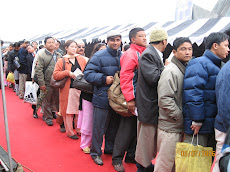
Subsequent to rest and relaxation for an hour, we drive down to the traditional house owned by the in-laws of Takum Chang. Except us, everyone else in town has supposedly hit the pillow. The typical Ekra construction, look of the drawing room and impressive spirit of hospitality once again bring back memories of Sikkim. We finish eating tasty food in roughly half an hour and bid good bye by profusely thanking the hosts. But for them, we would have remained hungry whole night. The challenging moments of the journey so far shall not deter me from visiting 8 to 10 villages in next three days to assess changing livelihood patterns of the people, I utter so, prior to switching off the dim lights. Temperature had come down drastically, but not my spirits.